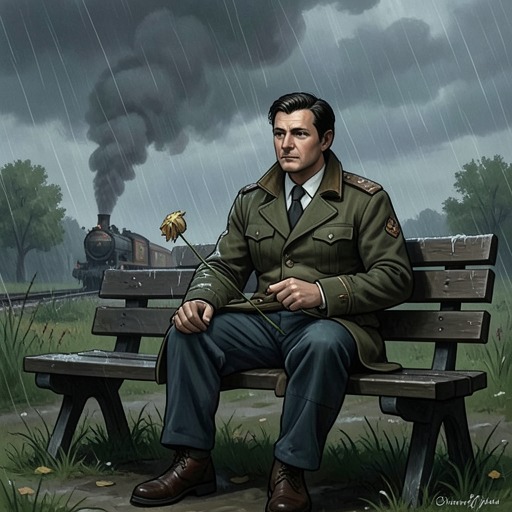
“Don't feel sorry for yourself. Only arseholes do that.”
Norwegian WoodNagasawa’s “Don't feel sorry for yourself. Only arseholes do that” is a hard-edged piece of advice that Toru Watanabe carries away from their parting and later recalls in a moment of emotional paralysis. Its significance lies in the tension between the action it can prompt and the limits it cannot overcome: the words help Watanabe move, but they do not make grief disappear or render loss a matter of will.
The advice at parting
Nagasawa delivers the line after joking that Watanabe and Hatsumi would make a good couple, then turning serious enough to offer one piece of advice. He predicts that trouble will come Watanabe’s way and calls him stubborn, before telling him not to feel sorry for himself. The two shake hands and go their separate ways: Nagasawa toward his new world, Watanabe back to what he calls his swamp. The exchange gives the maxim its first shape—not a general theory of suffering, but a terse charge from one friend to another at a moment of departure.
Watanabe says he will keep it in mind. Three days after moving, he writes to Naoko about his new house and his relief at leaving the dormitory’s “idiots” and “stupid brainstorms.” He imagines beginning a new life with a new frame of mind. That immediate hope makes the advice sound at first like an instrument of self-reinvention, although the story will return to the line under far more painful circumstances.
A prompt to act
After reading Reiko’s letter, Watanabe reads it repeatedly without being able to understand what Naoko’s invitation to have lunch means. His mind feels slack, and he recognizes that he must snap out of it. At that point Nagasawa’s words come back to him. Watanabe inwardly answers, “OK, Nagasawa. Right on,” sighs, and gets to his feet. The recollection does not resolve the confusing letter; it interrupts his immobility and gives him a reason to do the next ordinary thing.
He does his laundry for the first time in weeks, visits the public bath, shaves, cleans his place, shops for food, and cooks a decent meal. He feeds the starving Seagull, drinks only beer, and exercises for thirty minutes. Looking in the mirror while shaving, he discovers that he has become emaciated: his eyes are popping, and he can hardly recognize himself. The sequence makes the advice concrete as a brief return to bodily routine, while the mirror records how badly Watanabe has been neglecting himself.
Those actions do not amount to reassurance about Naoko. Watanabe recognizes that Reiko’s letter has shaken his optimistic belief that Naoko is getting better. Naoko had told him that her sickness had deeper roots than he thought, and Reiko had warned that nobody could tell what might happen. Watanabe had instead taken his two visits as evidence of improvement and imagined that the main question was whether Naoko could regain the courage to return to the world. Recalling Nagasawa’s maxim helps him respond to his own paralysis, not to control the outcome he fears.
Against grief’s limits
The line’s stern rejection of self-pity acquires a harsher context after Naoko’s death. In his travels away from Tokyo, Watanabe moves down the coast, perhaps in Tottori or on the hidden side of Hyogo. He sleeps on sand, makes fires from driftwood, roasts dried fish bought from a local fisherman, and listens to the waves while thinking of Naoko. Her absence remains difficult to absorb even after he has heard the nails being driven into her coffin. Memories return with physical vividness, as if she were still beside him, and then give way to the knowledge that her body no longer exists in the world.
In these passages, the book places Nagasawa’s advice beside Watanabe’s earlier understanding that death is part of life. He had come to see death not as life’s opposite but as something present within it, like fine dust breathed in by the living. Memories of Naoko carry him into an imagined place where the dead remain part of life; when that inward tide recedes, he is alone on the beach and sadness envelops him. The philosophical recognition can describe how death belongs to life, but it cannot spare him the pain of losing the person whose memories make that recognition intimate.
Watanabe states the limit directly: no truth, sincerity, strength, or kindness can cure the sorrow of losing a loved one. The only possibility he identifies is to see that sadness through to its end and learn from it, without imagining that what is learned will protect anyone from the next unexpected grief. His account thus qualifies the maxim rather than simply endorsing it. Refusing self-pity may help someone rise, wash, eat, and resume action; it cannot make mourning unnecessary or turn endurance into immunity.
The maxim’s unresolved return
On returning to Tokyo, Watanabe does not immediately rejoin the living. He shuts himself in his room for days, his memory fixed on the dead. He spends much of his time in rooms he has set aside for Naoko, with the furniture draped in white and the windowsills dusty. There he thinks of Kizuki and of the dead drawing parts of him into their world. The withdrawal shows how little a remembered injunction can command once grief has deepened into isolation.
The advice therefore remains deliberately incomplete. Nagasawa’s words offer Watanabe a way to break one spell of inertia, and the ordinary acts that follow show their immediate usefulness. But Naoko’s death exposes the danger of treating that usefulness as a cure: Watanabe’s reflections distinguish getting up from being healed, and continued life from an end to sorrow. The maxim is neither erased nor made triumphant; it persists as a prompt to act within a grief that it cannot abolish.